Text-to-Extrude
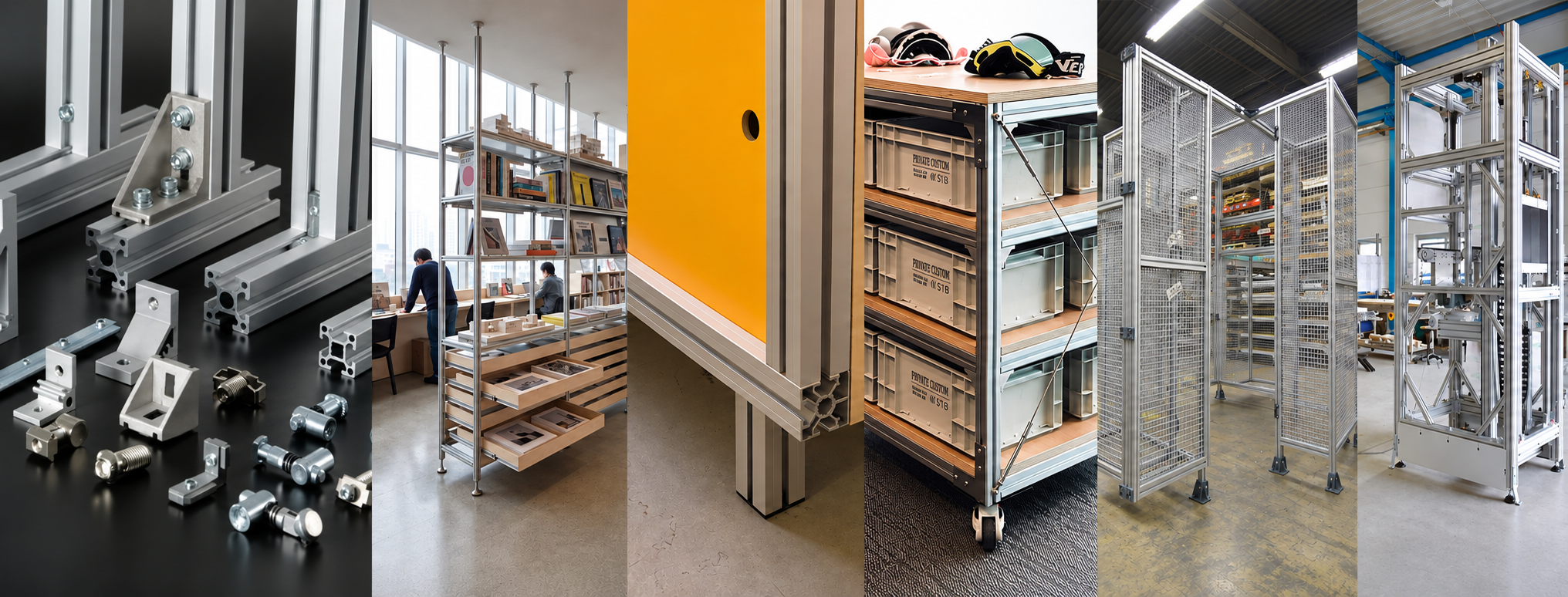
One tool I can't live without is aluminum extrusion profiles.
Even if you’re not familiar with it, you’ve probably seen it somewhere. It’s industrial-grade Lego, used to make frames, fixtures, workbenches, and equipment. It’s everywhere in hardware and manufacturing.
My first startup was basically a glorified aluminum extrusion redesigned (beautifully ;)) into a modular furniture system ¹.
As popular as it is, the design-to-purchase process is still extremely manual and uncertain. I tried to solve this with an online configurator for my own product in 2018 ², only to find that a fancy 3D configurator was quite useless in driving actual sales. In my experience, people wanted a configurator only because either 1) they couldn’t find an off-the-shelf design, or 2) it was fun to play with, without ever really buying anything.
Then came AI. I’d been experimenting with CAD and three.js for some time, and when Astra dropped, things finally started to click. With some tweaking, you can now generate real, buildable configurations just by prompting your requirements. My long-awaited idea had finally crossed a threshold: the arbitrage-to-overhead ratio was high enough to pursue.
There are two arbitrage factors: time and cost.
Time is how quickly you can get from design to purchase. Instead of starting from scratch, users enter a prompt and get a configuration tailored to their needs. A 3-4 hour design process comes down to 30 minutes or less. That’s roughly 6–8x time savings, enough to make this service actually valuable.
More interesting, and the real secret sauce, is cost arbitrage. A lot of people default to McMaster-Carr for next-day shipping and how easy it is to find the right parts. Other vendors get overlooked because their websites are harder to use, even when they offer comparable parts and shipping times at much lower prices. McMaster versus Misumi is one example.
So what happens when an agent makes the purchase without you even visiting those sites? We can find the right parts for less, pass some savings to the customer, and use the remaining gap to add a healthy margin.
On the overhead side, the business is relatively lightweight. No inventory or warehousing. The software is the product, working as the middleman between what someone wants to build and the parts they need.
So the ratio becomes:
overhead
To put some numbers to it, say the parts would normally cost $100 at McMaster (by far the most popular option). At 35% sourcing savings, that’s $35. Then put a value on the time saved: assuming $30 an hour, saving 2.5–3.5 hours is worth another $75–$105.
If we reasonably assume $10 in operational overhead per order, the ratio becomes:
That’s $11–$14 in customer value for every $1 of overhead. These are very bare assumptions, but I would consider anything above 10x to be in the "software margins" territory. It's why this idea is very appealing to me, since it's a new type of software business in the hardware space that couldn't be unlocked without AI.
Of course the caveat here is that we're assuming relatively attainable CAC and service costs, etc.
Why I think this will work, practically
The customers for aluminum extrusion systems are often businesses, not individuals. That means higher order values, with buyers who are likely already familiar with the system, often with bins already filled with excess parts, therefore lower maintenance and service requirements. This is another reason the arbitrage-to-overhead ratio looks attractive.
I’m also betting on some virality (word of mouth), granted the service works well. The existing configurators ³ from incumbents like 8020 or item24 always draw attention within my inner circles, but everyone reverts back to their CAD software because it's eaiser to use and simple to build with parts from your intended supplier (e.g. McMaster-Carr).
The real test is whether this can get someone all the way from an idea to ordering the parts, without that detour back to CAD. If it can, I think engineers will share it.
Behind the scenes
The idea is simple. I used Codex for the most part, with the goal for a simple proof of concept site/demo that can be built in couple hours or less.
I should note that a lot of the speed came from reusing earlier work. The 3D configurator and visualization started as an internal manufacturing tool I built for Airform (my last startup), then edited in another personal project. For the website, I used my own pre-baked skill for a “minimal-brutalism” look.
AI did most of the work. I gave Codex a rough plan, asked for a flowchart of the stack, then started with the configurator. Here’s what AI did and where it needed me:
Configurator + Landing page
Once the configurator was roughly together, the landing page was pretty straightforward. AI used the same design skill, with some back and forth to get it to my liking. I always try to timebox design so I don’t get caught up. This took around 30 minutes. Good enough for a proof of concept.
Even from this quick exercise, tacit knowledge was the biggest gap between AI producing slop and something actually useful. Knowing which parts work best for everyday builds and how they fit together in real life was where I had to contribute the most.
Overall, I think these types of businesses are some of the lower-hanging fruits for agent-led business automation. The problem space where inefficiencies were already there, but AI being able to eliminate the friction without adding any operational overhead.